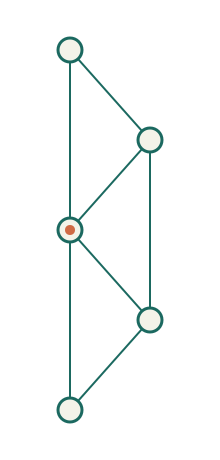
Six points. One unbroken journey.
Draw six points as two rows of three, leaving a generous gap between them. Your first task is to join all six with one continuous path. Visit each point once, use only straight segments, and keep the pencil on the paper until the end. There is more than one answer, so save the first route and look for a second.
The first version of this exercise allowed any line to cross another. It was pleasant but not particularly revealing. I added a second rule: no crossings. This changed where I began. Starting at a corner seemed natural, yet starting in the middle made me consider the empty spaces between points more carefully.
For the stitched version, mark the same six points on a piece of scrap cloth. Use a simple running stitch along your chosen route, leaving the thread comfortably loose. Watch what happens at a sharp turn. On paper, the corner is only a change of direction. In cloth, it becomes a place where tension gathers and the surface can pucker.
To compare the two versions, set them side by side and write one sentence about each. My paper note said, “The shortest-looking path was not the first one I noticed.” My cloth note said, “The corner needs room.” Neither observation is a theorem. Both give me a sensible starting point for the next small experiment.
Change one rule
Try a seventh point halfway between the rows. Keep the other conditions the same, and notice which old routes still work.